
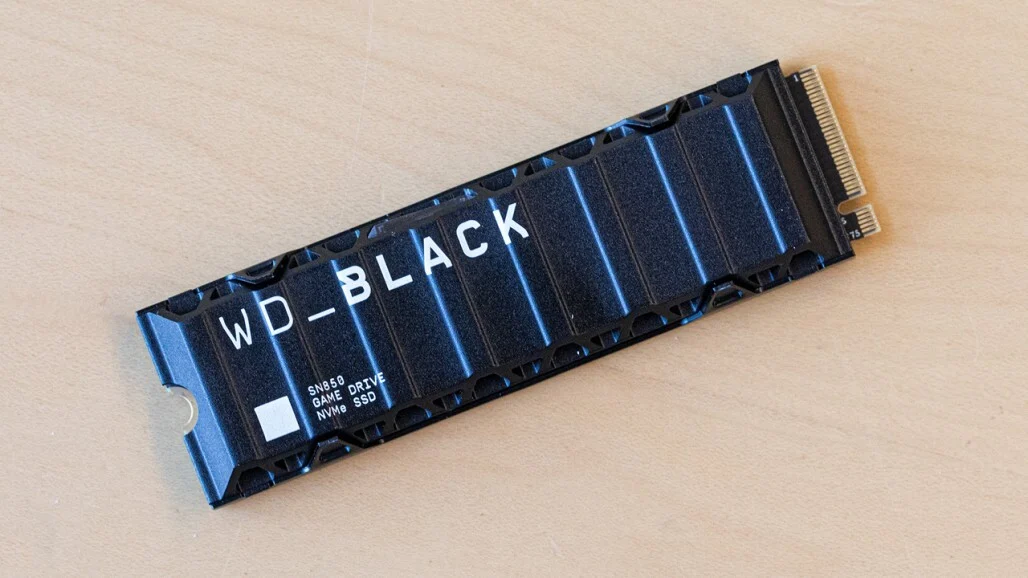
Picking the best SSD for gaming feels straightforward until you open a spec sheet and suddenly you are inundated with MB/s speeds, PCIe generations and types of NAND that by themselves are meaningless without context. The bottom line is that a faster SSD will not get your frame rate up to even higher levels; however, this will make your entire gaming experience feel more accurate, quicker and less irritating. You have a shorter load time, your operating system has a shorter boot time, and open-world games stream data without the stuttering appearance. The drive under your GPU will make a difference to most people more than they think.
What Makes the Best SSD for Gaming Different from Regular Storage
Not all fast SSDs are great gaming SSDs. Random 4K read speed is the actual number that rules the game playing performance, rather than the sequential read figure that is stamped on the box. Games load data in tiny, spaced-out chunks a texture here, a sound file there, a character model elsewhere. A drive with such small random operations will always be faster in actual gameplay than one with higher sequential numbers and a lower 4K.
Sequential speed is important when copying big files or when installing games from external storage. Random 4K speed is important at least once when you press the Load Game button. So remember that difference when comparing drives.
Best SSD for Gaming: Top Picks in 2026
| Drive | Interface | Sequential Read | Random 4K Read | Best For |
| WD Black SN7100 | PCIe 4.0 | 7,250 MB/s | ~101 MB/s | Best overall |
| Biwin Black Opal NV7400 | PCIe 4.0 | 7,400 MB/s | Average | Best budget |
| WD Black SN8100 | PCIe 5.0 | 14,900 MB/s | ~119 MB/s | Fastest available |
| Crucial P510 | PCIe 5.0 | 11,000 MB/s | Average | Budget Gen 5 |
| Team Group MP44 4 TB | PCIe 4.0 | 7,400 MB/s | Average | High capacity |
| Lexar Play 2230 | PCIe 4.0 | 5,200 MB/s | Good | Steam Deck / handheld |
| Silicon Power XS70 | PCIe 4.0 | 7,300 MB/s | Good | PS5 expansion |
WD Black SN7100
WD Black SN7100 would take the first place since it will be balanced in all the measurements that a gamer truly requires. It swaps Kioxia 218-layer BiCS8 TLC NAND with SanDisk Polaris 3 controller, and the outcome is a drive with a random 4K read score of 101 MB/s in a benchmark test, which is better than any rival drive costing the same. It is cooler, is single-sided on the PCB, and does not access a DRAM cache but suffers no evident game load penalty.
This SSD comes in 500 GB, 1 TB, 2 TB, and 4 TB variants. The 2 TB model is a sweet spot between capacity and cost for most gaming constructions. Consider this: when you switch between Windows and a game or a load screen seems longer than it should, a drive such as the SN7100 corrects this type of noticeable performance flaw with a single initial boot.
Biwin Black Opal NV7400
Budget gaming SSDs typically require you to compromise either speed or capacity. The Biwin Black Opal NV7400 does not make that trade-off. With a cost of around 0.06 U.S. dollars per gigabyte in the 2 TB version, it is lower than all competitors in the market. Sequential read performance approaches 7,400 MB/s, just over PCIe 4.0, and is extremely cool, helped by its cache-free and efficient architecture.
The honest trade-off here is random 4K write performance, which lags behind premium drives like the SN7100. In practice, that means slightly slower in-game saves and asset writes, but load times still feel fast and responsive. For a build where storage budget is tight, the NV7400 delivers genuine PCIe 4.0 speed without compromise on capacity.
WD Black SN8100
The WD Black SN8100 is the clearest example. Using SanDisk’s proprietary SMI2508 controller and 218-layer BiCS8 NAND, it hit 14,710 MB/s sequential read and 119 MB/s random 4K read in testing. It peaks at around 74°C acceptable for a Gen 5 drive. In the Final Fantasy XIV: Shadowbringers load time benchmark, it posted measurably faster results than every Gen 4 drive tested. That’s real-world proof that random 4K performance at this level does translate to gaming.
Crucial P510
The Crucial P510 is bringing the Gen 5 to the lower price point. The Phison E31T controller (designed around TSMC’s 7nm process) reaches the lowest temperature of only 64°C, in a 7mm drive. The sequential read speed is about 11,000 MB/s, and the 1 TB model will be priced at approximately $100, comparable to premium Gen 4 pricing.
Lexar Play 2230
Gaming PCs Handheld game PCs employ M.2 2230 (30mm rather than 80mm) long. There are not many choices, and in that case, the Lexar Play 2230 1 TB appears very distinct. It has Micron B47R 176-layer TLC and Nanden, a TLC controller to be run with the SM2269XT that runs at average temperatures of about 40 °C but reaches a high of 53 °C. The fact that heat is felt in a handheld and the battery life and heat of the device are real.
Its pseudo-SLC cache measures approximately 240 GB, which is large for a 2230 drive and helps maintain write performance during big game installs. The only limitation is availability only 1 TB is currently offered in this model.
Silicon Power XS70
Sony’s PlayStation 5 accepts M.2 NVMe SSD expansion and requires a minimum sequential read speed of 5,500 MB/s. The Silicon Power XS70 2 TB exceeds that comfortably at 7,300 MB/s read and 6,800 MB/s write. It uses the Phison PS5018-E18 controller with Micron 176L TLC NAND, and its included heatsink is slim enough to fit the PS5’s M.2 bay without clearance issues. It shares its core hardware architecture with the Seagate FireCuda 530 and Kingston KC3000, both consistently well-regarded drives, which speaks to its reliability.
How Much Storage Does the Best SSD for Gaming Actually Need
Two terabytes is the practical minimum in 2026. Games such as Red Dead Redemption 2 occupy around 150 GB, Call of Duty games are oftentimes over 100 GB, and Cyberpunk 2077 with extras downloads 80GB. A 1 TB drive with Windows, necessary applications, and three or four AAA games is filled quicker than anticipated. You will not only spend a lot of time installing games, but also you will spend a lot of time uninstalling them.
The Team Group MP44 4 TB is the solution with a neat solution to this headache. It has common hardware to the Lexar NM790 and can provide 7,400 MB/s sequential reads at a cost significantly lower than the cost of 4 TB NVMe storage was in the past. It requires a motherboard M.2 heatsink to prevent thermal throttling when making sustained transfers, but when used normally in gaming, it works dependably.
The WD Black SN850X 8 TB is available at an MSRP of $649 in the case of single-drive extremists. It uses a Triton MP16+ B2 controller and Kioxia 162-layer BiCS6 NAND. The catch is that housing four NAND chips introduces slight latency, making random 4K performance weaker than that of smaller drives. It’s better suited as a mass storage drive than a pure gaming boot drive.
Common Mistakes People Make When Choosing the Best SSD for Gaming
Buying based on sequential speed alone is the most common error. A drive advertising 7,400 MB/s means little if its random 4K write performance is weak. Always check both numbers before deciding.
Skipping the heatsink on Gen 5 drives causes real problems. Gen 5.0 -based SSDs throttle at full load and perform poorly when compared to Gen 4 at passive or active loads in the absence of active cooling. An additional error is to make the purchase with an insufficient size because a drive of 1 TB seems to be big enough, but three updates to the game come at the same time.
Lastly, don’t forget to check the compatibility of M.2 slots on your motherboard. A PCIe 4.0 drive installed in a PCIe 3.0 slot will operate, but will be limited to about 3,500 MB/s instead of the reported 3.5 GB/s on the drive.
Final Thought
The best SSD for gaming in 2026 will depend on your financial capabilities and application, though the WD black SN7100 can make the best case to most people. It is high where it is required in gaming and it is cool as well as cheaper than a number of slower options. On a tight budget, the Biwin NV7400 will be the most cost-effective gigabyte. Want to have as fast storage as anything currently on the market with none of the thermal nightmares of drives out in earlier generations, then the WD Black SN8100 can deliver it. Choose the drive that fits your motherboard, your wallet, and the size of your game collection and then relax and start playing.
Read More Blogs; Best Budget Monitors for Gaming: What Actually Matters Before You Buy
